
Montmorency County Arrest to Court Records
A Montmorency County arrest can begin with a sheriff deputy, Michigan State Police, a local officer, or a warrant from a court. If the person is held instead of cited and released, Montmorency inmates are housed at Alpena County Correctional Facility. That booking is a custody event. It may create a booking number, charge text, bond fields, arresting-agency data, and a public roster entry if the person appears on the Alpena JailTracker current-inmates system.
The court record begins when the criminal matter is opened in court. The 88th District Court handles criminal misdemeanors, felony arraignments, preliminary examinations, and pleas. Felony matters that move beyond early district-court stages may proceed to the 26th Circuit Court, where the County Clerk serves as clerk of the circuit court and keeper of court filings. The Montmorency County Prosecutor Office reviews law-enforcement reports and decides which charges to authorize or pursue.
That split matters when comparing court records after arrest with jail records. The roster can help identify the booking date, booking number, arresting agency, bond type, and visible booking charges. Court records are the stronger source for formal counts, amendments, dismissed charges, hearing dates, case status, financial history, and final disposition. For custody and booking details, use Montmorency County jail inmate records. For court records after a jail arrest, use the court search and clerk channels described here.
Find Montmorency County Court Records
Montmorency Courts publish a local case-search page for Alpena and Montmorency County cases. The court page says the search provides register of actions, hearing dates, party names, counsel, case status, and financial history. It also warns that the online case search does not provide copies of documents and does not show non-public or suppressed cases. That makes it useful for tracking court records after an arrest, but not a substitute for contacting the court when certified copies, complete filings, or sealed-material questions are involved.
Use the Montmorency Courts case-search page as the local lead source. It points users into the court search process by county and court. The statewide MiCOURT Case Search portal is also relevant for public court records. Because the MiCOURT public interface is dynamic, the static research did not capture every field label, but local court research confirms that party names, hearing dates, case status, counsel, financial history, and register-of-action data are the key outputs for criminal case tracking.
| Search Field or Control | Use for Court Records After Arrest | Notes |
|---|---|---|
| Court selection | Choose the Montmorency court or county path. | Montmorency court display covers Circuit, District, Probate, and Juvenile calendars, but criminal public access centers on adult public criminal cases. |
| Party or defendant name | Search the arrested person's name. | Names can vary by spelling, middle initial, suffix, or alias. |
| Case number | Go straight to a known case. | Use it when a summons, notice, bond paper, or roster field gives a case number. |
| Case or court type | Separate district starts from circuit filings. | Misdemeanors and felony starts are district matters; bindover can move a felony toward circuit court. |
The local Montmorency Courts case-search page shows the kind of court-record information available online.
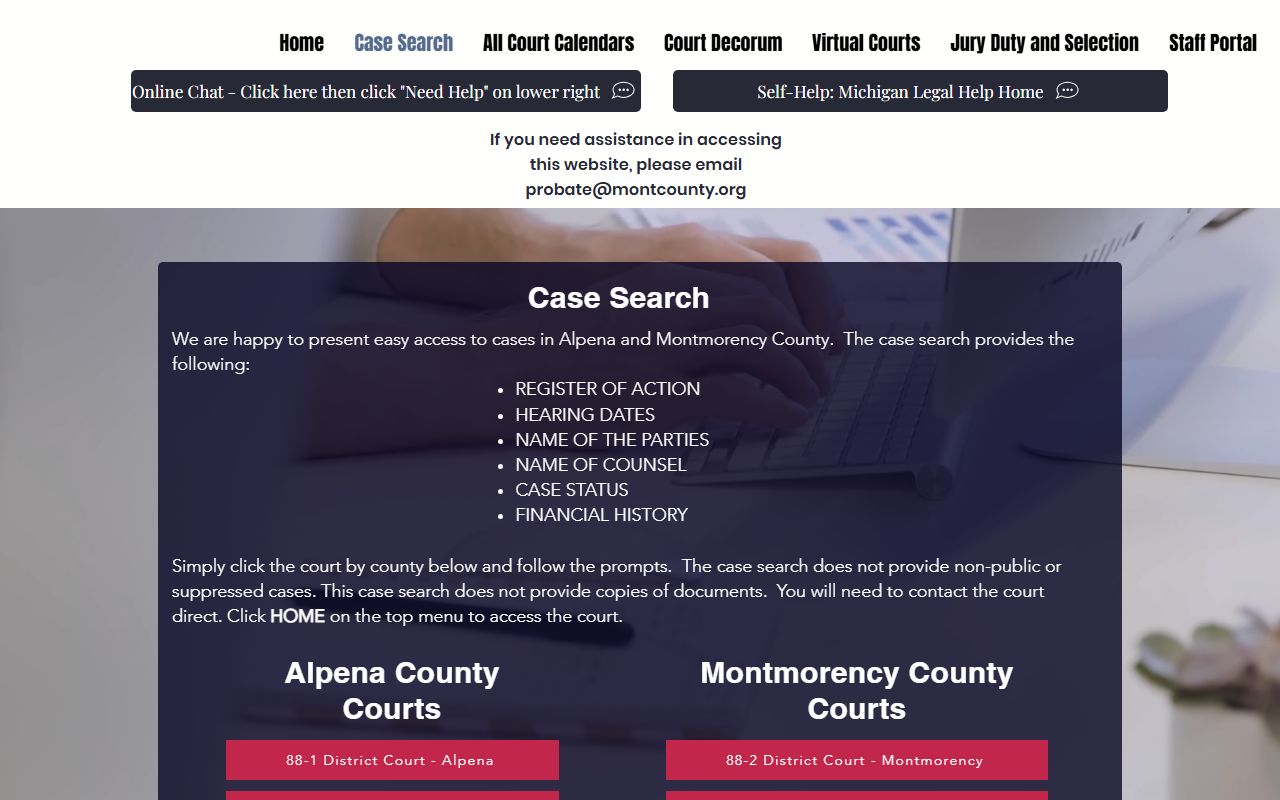
That source is best for confirming whether an arrest has become a public court case and whether the online record has status, hearing, party, counsel, and financial-history entries.
Search Court Records After Arrest
A reliable court-record search starts with the booking facts, then checks the court case. Booking data can be incomplete during the first hours after arrest because bond and court paperwork update as staff receive documents. Court data can also lag if a case has not yet been filed, if a prosecutor has not authorized charges, or if the matter is suppressed by statute or court order.
- Check the current jail roster or custody source for the booking date, arresting agency, booking number, visible charge text, and bond type if those fields are shown.
- Search Montmorency court records by defendant name. If a case number appears on court, bond, or warrant paperwork, search that number too.
- Start with 88th District Court for misdemeanors, felony arraignments, preliminary examinations, and early pleas.
- For felony cases after bindover or circuit-level filings, check the 26th Circuit Court path or contact the County Clerk for court-file access.
- When the portal shows a case but not documents, contact the court directly. The local case-search page states that document copies are not provided online.
The statewide MiCOURT Case Search portal is another entry point for public court records after a Montmorency County arrest.
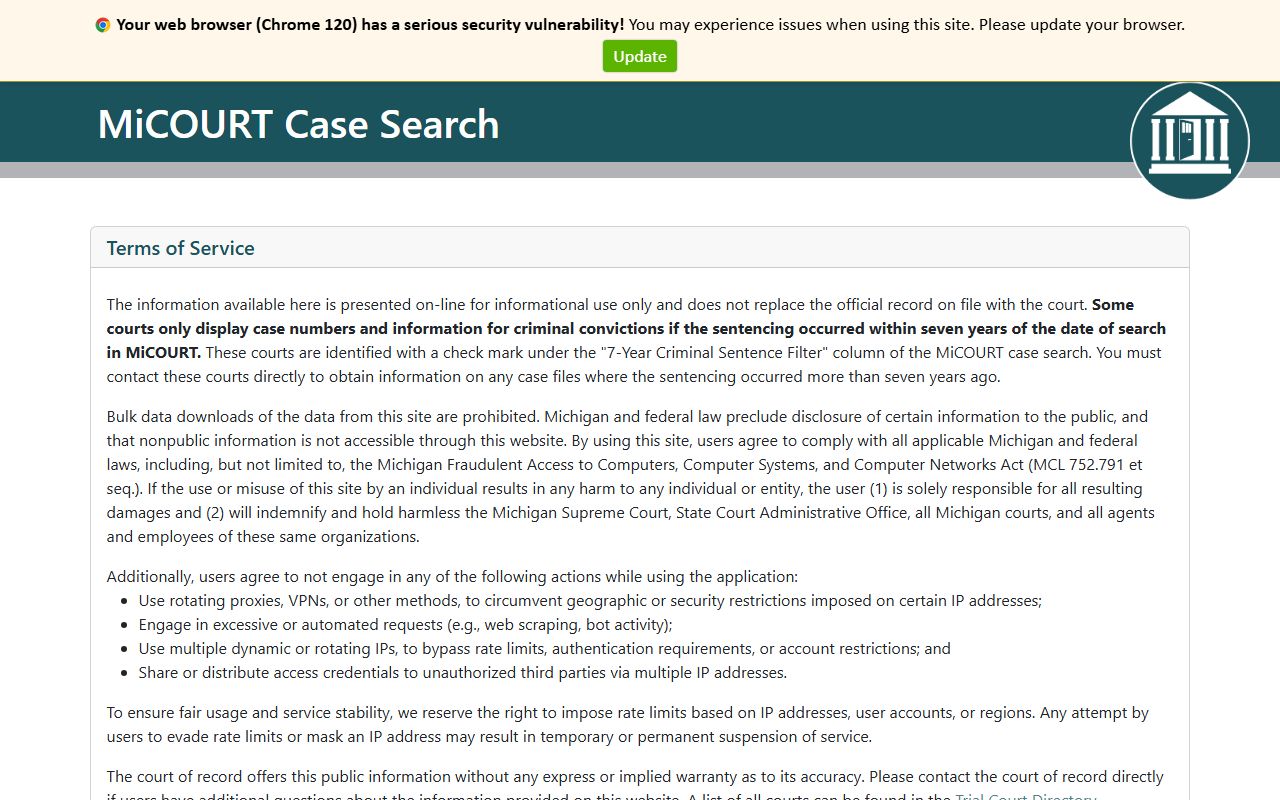
Use MiCOURT to confirm public case activity, then use the local court or clerk when the needed record is a copy, certified filing, or item not displayed by the portal.
Montmorency County Arrest Charging Records
The charging document is the point where the arrest allegation becomes a court case. In Montmorency County, the prosecutor's role is central after booking. The prosecutor reviews law-enforcement reports and decides what formal charges to authorize, pursue, amend, or dismiss. A booking charge on a jail roster may be only the first label attached to the arrest. The court record should be checked for the count that was actually filed.
| Document | Who Uses It | How It Fits Court Records After Arrest |
|---|---|---|
| Complaint | Prosecutor or law-enforcement filing path | Often starts a criminal case and sets out the accusation for early court action. |
| Information | Prosecutor | Common after preliminary stages in felony practice when a case moves toward circuit court. |
| Indictment | Grand jury process | Less common in routine local cases, but it is another formal charging route for serious criminal matters. |
Michigan courts and prosecutors use specific criminal procedure terms, but the practical point is simple: an arrest is not the final charging decision. Formal court records after a jail arrest may show a different offense, a changed count, or no filed charge if the prosecutor declines to proceed.
Montmorency County Charge Status
Charge status is the current place of a count in the case. It can change at arraignment, after prosecutor review, at a preliminary examination, by plea, by motion, or at sentencing. Court records are the better source for status because the jail roster may not track each legal step. JailTracker app resources expose charge-status fields, but court status controls the legal case.
| Status | Plain Meaning | Why It Matters |
|---|---|---|
| Pending | The charge or case has not reached final disposition. | Future hearings, bond terms, or plea discussions may still be active. |
| Amended | The filed charge changed from the earlier wording. | The court record may differ from the booking charge seen after arrest. |
| Reduced | The charge was lowered to a lesser offense. | A searcher should not treat the original arrest label as the final case result. |
| Dismissed | The charge was terminated by court or prosecutor action. | A dismissal is not a conviction, though public case history may still exist unless restricted. |
| Bound over | A felony moved from district court toward circuit court. | The next public record may appear in the 26th Circuit Court file. |
| Disposition | The final result of a count or case. | This is where the record can show conviction, dismissal, plea result, or another outcome. |
Note: If a court record is suppressed, sealed, or non-public by law, it may not appear through the public search portal.
Bond and Warrants After Arrest
Bond information connects the jail record to the court record. Alpena County's bond page says bond information for inmates is found under the Current Inmates roster menu item and updates as documentation is received. Published bond types include PR, NO BOND, CASH ONLY, 10%, and CASH/SURETY. A PR bond means release on personal recognizance, subject to any intoxication or substance-related hold noted by Alpena. No bond can mean no amount has been received from the court yet, or the court denied bond.
Alpena also explains that a payer can post bond in the offender's name or in the payer's own name. If the money is in the offender's name, it can be applied to fines and costs at the end of the court process. If a third-party depositor wants possible return of the money, the bond must be posted at the facility in the payer's name with the required paperwork. Online posting is through JailATM, and the county publishes booking, warrant, and card or cash transaction fees.
No official Montmorency County online active-warrant search was found in the reviewed sources. Warrant information may appear through court records, jail booking records after arrest, or sheriff records. A bench warrant, arrest warrant, fugitive warrant, or outside-agency hold can affect release even when another charge has a bond amount. Court staff can provide public case status, but they cannot give legal advice.
Charges vs Convictions
A court record after arrest should not be read as proof of guilt unless it shows a conviction or plea result. An arrest is a custody event. A charge is an accusation filed or pursued in court. A conviction is a finding or admission of guilt. That distinction matters for employment, housing, licensing, and personal record review, and it is also why the court case status should be checked before repeating arrest-charge information.
| Record Type | What It Means | What It Does Not Prove |
|---|---|---|
| Arrest | A person was taken into custody or lodged on an allegation, warrant, or hold. | It does not prove the prosecutor filed the same charge. |
| Charge | A criminal count is pending or was filed in court. | It does not prove guilt. |
| Conviction | The case ended in a guilty plea, verdict, or qualifying finding. | It does not mean every original arrest charge survived unchanged. |
Sealed and Expunged Records
Michigan public access starts with the policy in MCL 15.231, which favors access to public records of government bodies. That access is not absolute. MCL 15.243 allows exemptions and redactions, including certain law-enforcement and privacy material. Courts may also keep juvenile, suppressed, sealed, or otherwise non-public records out of the public portal.
| Category | Sealed | Expunged or Set Aside |
|---|---|---|
| Public visibility | Hidden from ordinary public access by law or court action. | Treated under Michigan set-aside rules so eligible conviction records are no longer public in the same way. |
| Official access | Some agencies or courts may retain limited access. | Access and effect depend on the set-aside statute and the record type. |
| Michigan source | Court order, statute, or suppression rule may control. | MCL 780.621 governs eligible set-aside convictions. |
Set-aside questions should be handled through the court record, not by asking a roster vendor to erase a case. MDOC OTIS research notes that information is removed when a conviction is set aside or expunged by the sentencing court or by operation of law. County court and booking-photo questions also depend on the record-holding office and any court order.
Montmorency County Prosecutor Records Role
Michigan uses county prosecuting attorneys rather than district attorneys. The Montmorency County Prosecutor Office is led by Prosecutor Vicki P. Kundinger, with Assistant Prosecutor Luke Kwiatkowski and victim advocate staff listed by the county. After an arrest, that office reviews reports and decides what charges to authorize or pursue. The prosecutor's decision is one reason the final court record can differ from the first booking entry.
Victims and witnesses may also see the case move through VINE or prosecutor victim-services channels. Michigan VINE is available as a free, confidential, 24-hour custody and case-information notification service. VINE is useful for notification, but the court record remains the source for filed charges, hearings, and disposition.
Important: Public court lookups are not FCRA consumer reports and should not be used for employment, tenant, credit, insurance, or other FCRA-covered decisions.